// LOADING
LoadingAI RISK & GOVERNANCE
Govern AI with frameworks that fit
We build custom risk frameworks and controls aligned to the NIST AI Risk Management Framework, shaped around how your organization actually uses AI.
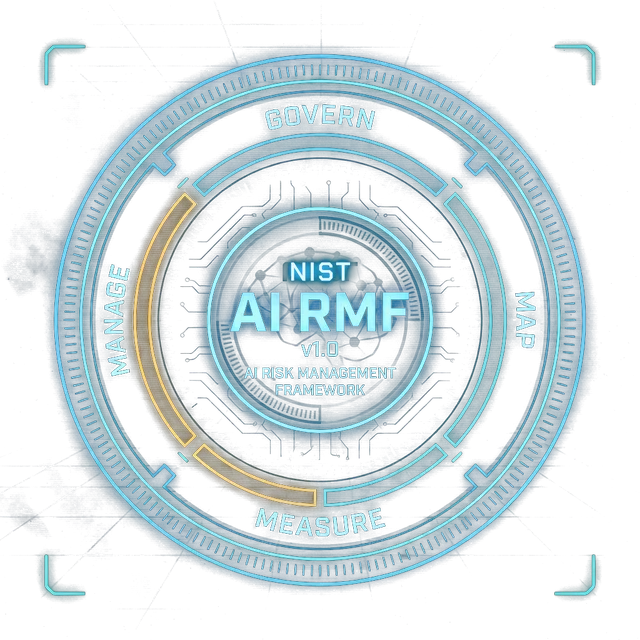
Govern · Map · Measure · Manage
Every organization uses AI differently, so a copied policy rarely survives contact with reality. We start from the NIST AI Risk Management Framework, then build controls around your real systems, data, and obligations. We follow the specific places a model touches patient records or moves money, rather than handing you a generic checklist.
This work matters most for healthcare and other governed entities, where the cost of getting it wrong is measured in regulatory exposure and trust. We map your AI use against the standards that apply to you, identify where the genuine risk lives, and put governance in place that holds up to scrutiny while still letting your teams move. We reference HIPAA, HITRUST, SOC 2, and PCI DSS where they apply, and we are clear about what is alignment versus formal certification.
Outcomes
- Governance grounded in the NIST AI RMF
- Controls that match your actual AI usage
- Clear risk visibility across models and data
- Defensible posture for healthcare and governed entities
The NIST AI RMF, in four functions
Govern
Set the policies, roles, and accountability for AI.

Map
Locate where AI touches data, money, and people.
Measure
Test and quantify the risk you find.
Manage
Prioritize, treat, and monitor it over time.
How we govern AI risk
AI RMF alignment
Your governance should hold up the moment a regulator or your own board starts asking hard questions.
GOVERNANCEDetail
Custom risk frameworks
Off-the-shelf controls leave gaps in the places that matter most to your business.
CONTROL DESIGNDetail
AI system risk assessment
Risks you cannot see are the ones that surface at the worst possible moment.
RISK SCANDetail
Healthcare and governed-entity controls
The organizations that trust you with sensitive work expect protection built for the weight of that responsibility.
PHI SAFEGUARDSDetail
Standards mapping
An auditor should never tell you something about your own compliance posture that you did not already know.
COMPLIANCEDetail
AI red teaming and adversarial testing
It is better to learn how your AI fails under conditions you control than to discover it live.
RED TEAMDetail
Standards we map against
NIST AI RMF
The framework our governance is built on
HIPAA
Protected health information
HITRUST
Healthcare security assurance
SOC 2
Trust services criteria
PCI DSS
Cardholder data
We are clear about where you align versus where you hold formal certification.
Service FAQ
What framework do you base AI governance on?
We structure governance on the NIST AI Risk Management Framework and its four functions of Govern, Map, Measure, and Manage, so your program rests on a recognized standard rather than ad hoc rules. We then build controls around your real systems, data, and obligations rather than copying a generic policy. We are clear about what is alignment versus formal certification.
Why not just adopt a standard AI policy template?
A copied policy rarely survives contact with reality, because two AI deployments rarely carry the same risk. We build controls around how your organization actually uses AI and how a model touches patient records or moves money, not around a generic checklist. That protects what makes your work different.
Do you handle AI governance for healthcare and regulated work?
Yes. This work matters most for healthcare and other governed entities, where the cost of getting it wrong is measured in regulatory exposure and trust. We design safeguards for regulated work where AI touches protected health information and the room for error is small. We map your AI use to HIPAA, HITRUST, SOC 2, and PCI DSS where they apply.
Do you test our AI for vulnerabilities before attackers find them?
Yes. We run structured attacks against your AI to surface prompt injection, jailbreaks, and data leakage before attackers or auditors do, then feed every finding back into your controls. The NIST Generative AI Profile calls for this testing. We also examine your models, data flows, and integrations to rank where the genuine risk lives.
Govern your AI before the questions come
Tell us how your organization uses AI and we will build the risk framework that keeps it safe, accountable, and ready for the standards you answer to.